Digestive symptoms are a recognizable part of tirzepatide treatment, but are they responsible for its weight-loss effect? A 2025 analysis of the SURMOUNT-1 through SURMOUNT-4 trials approached that question by comparing weight changes in participants who did and did not report certain gastrointestinal symptoms. Both groups lost substantial weight. That finding challenges the idea that feeling sick is necessary evidence that treatment is working, without making digestive symptoms unimportant.
The details matter for a safety-focused reading. This was an exploratory reanalysis of existing trials, not an experiment that assigned people to experience nausea. Its main symptom grouping covered nausea, vomiting, or diarrhea—not every digestive disorder—and one reported episode was enough to enter the symptom group. The analysis also excluded weight measurements after treatment discontinuation. Understanding those choices helps separate a useful finding about weight loss from claims the research did not establish about individual tolerability, mechanisms, or symptom management.
SURMOUNT-1: weight change in participants with and without reported nausea, vomiting or diarrhea
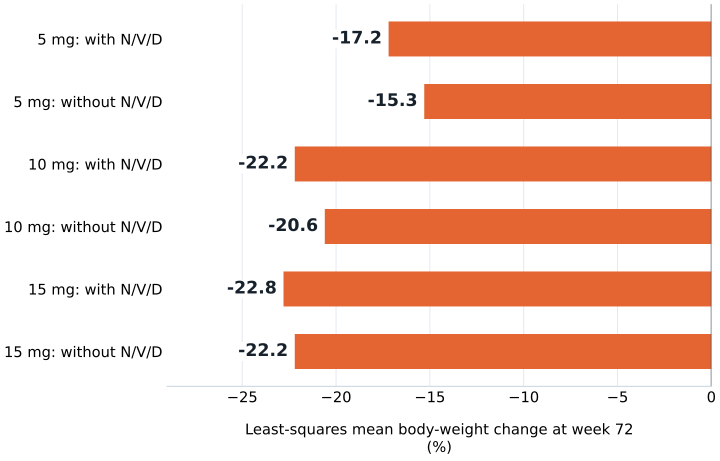
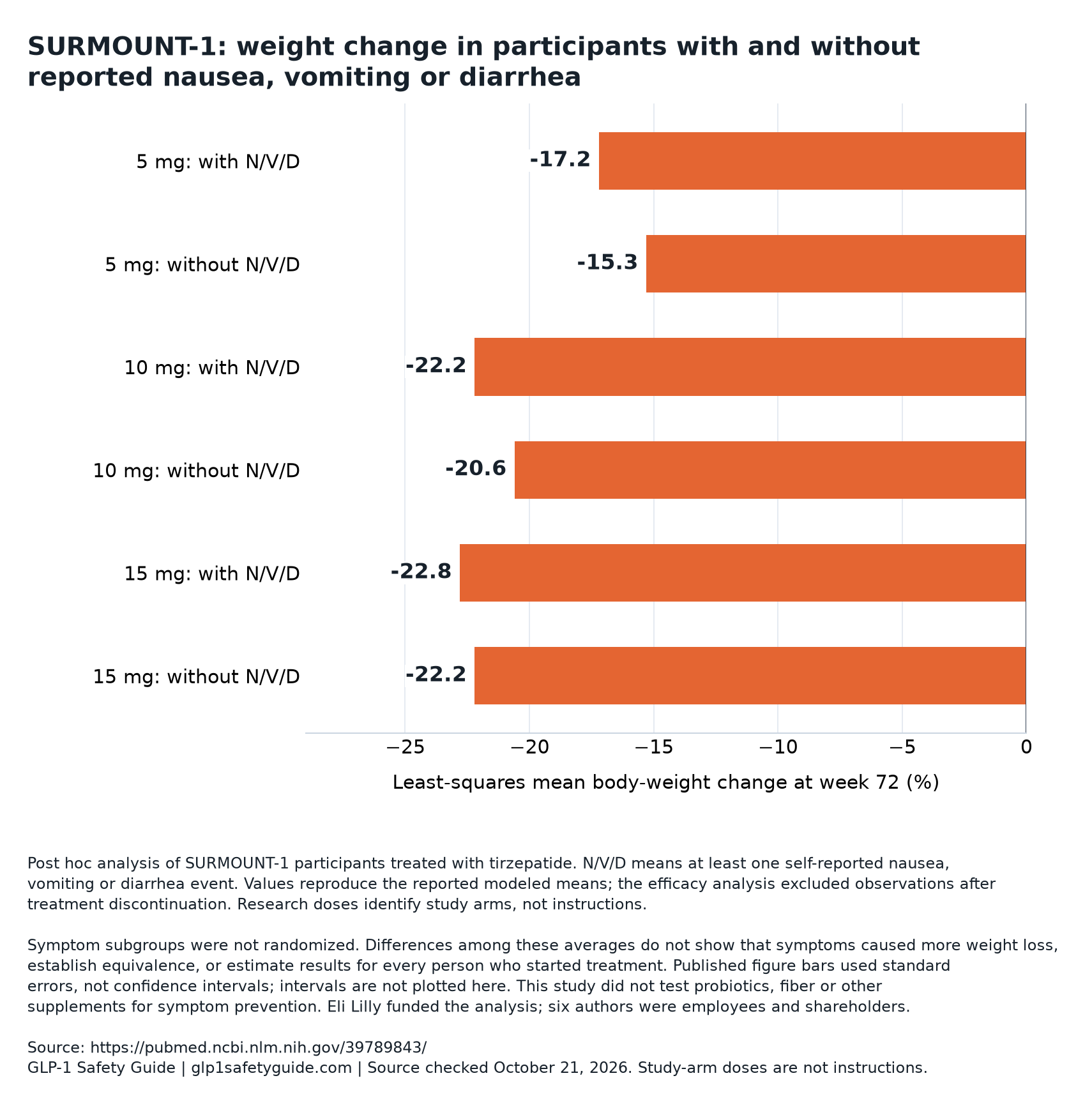
Post hoc analysis of SURMOUNT-1 participants treated with tirzepatide. N/V/D means at least one self-reported nausea, vomiting or diarrhea event. Values reproduce the reported modeled means; the efficacy analysis excluded observations after treatment discontinuation. Research doses identify study arms, not instructions.
Symptom subgroups were not randomized. Differences among these averages do not show that symptoms caused more weight loss, establish equivalence, or estimate results for every person who started treatment. Published figure bars used standard errors, not confidence intervals; intervals are not plotted here. This study did not test probiotics, fiber or other supplements for symptom prevention. Eli Lilly funded the analysis; six authors were employees and shareholders.
Source 1Download the source-labeled chart (PNG) · Download the data (CSV)
| Randomized dose and nonrandomized symptom subgroup | Reported value |
|---|---|
| 5 mg: with N/V/D | -17.2 |
| 5 mg: without N/V/D | -15.3 |
| 10 mg: with N/V/D | -22.2 |
| 10 mg: without N/V/D | -20.6 |
| 15 mg: with N/V/D | -22.8 |
| 15 mg: without N/V/D | -22.2 |
Sections in this article
Four trials with different starting points
SURMOUNT evaluated once-weekly subcutaneous tirzepatide against placebo in adults with obesity or overweight. SURMOUNT-1, -3, and -4 excluded type 2 diabetes and generally required a body mass index of at least 30, or at least 27 with a weight-related condition. SURMOUNT-2 enrolled adults with type 2 diabetes and a body mass index of at least 27. Lifestyle counseling accompanied treatment.
These were randomized trials, but their treatment histories differed. SURMOUNT-3 randomized participants after a 12-week intensive lifestyle program. SURMOUNT-4 began with 36 weeks of open-label tirzepatide, followed by 52 randomized weeks of continued treatment or placebo: 88 weeks total, not another 88 weeks after the lead-in.
The post hoc report mostly analyzed each trial separately. That preserves important distinctions: beginning medication after lifestyle-associated weight loss is not the same experiment as withdrawing medication after months of exposure. The doses below identify research arms, not instructions for choosing or changing treatment.
| Trial | Population and comparison | Endpoint timing |
|---|---|---|
| SURMOUNT-1 | Without type 2 diabetes; tirzepatide 5, 10, or 15 mg versus placebo | Week 72 |
| SURMOUNT-2 | With type 2 diabetes; tirzepatide 10 or 15 mg versus placebo | Week 72 |
| SURMOUNT-3 | Without type 2 diabetes; maximum tolerated 10 or 15 mg versus placebo after lifestyle lead-in | 72 weeks after randomization |
| SURMOUNT-4 | Without type 2 diabetes; continued maximum tolerated 10 or 15 mg versus placebo after open-label tirzepatide | Week 88 from initial treatment start |
One episode determined the symptom category
Participants reported adverse events in response to open-ended, non-leading questions. Investigators recorded onset, end date, and severity. For the main weight analysis, one episode of nausea, vomiting, or diarrhea—abbreviated N/V/D—was sufficient to classify someone as having symptoms. A person with one brief episode and someone with repeated episodes could therefore occupy the same category.
That binary definition makes the comparison understandable but compresses symptom burden. It does not directly measure how many days someone felt unwell, whether symptoms interrupted daily life, or how often they recurred. The trials did not use systematic symptom-severity scales for this analysis, and reporting could differ among individuals or regions.
Importantly, the no-N/V/D group was not necessarily free of all digestive problems. Constipation was not part of the primary definition. Dyspepsia, meaning indigestion or upper-abdominal discomfort, was added in a sensitivity analysis to see whether a broader definition changed the interpretation. A clear medication-problem account can preserve timing and recurrence details that a yes/no research category loses.
Source 1The dose-specific weight changes tell the central story
The efficacy outcome was percentage change in weight from baseline to each trial’s primary endpoint. Researchers used a repeated-measures model to estimate mean changes within symptom subgroups. In SURMOUNT-1, every tirzepatide dose produced substantial average reductions in participants both with and without reported N/V/D.
The numerical gaps between those groups were 1.9 percentage points in the 5-mg arm, 1.6 points in the 10-mg arm, and 0.6 points in the 15-mg arm. These are differences between group-average percentage changes, not percentages of people benefiting. Their size also does not establish that symptoms produced the difference.
The figure’s error bars represent standard errors, which describe uncertainty around estimated means; they are not 95% confidence intervals. The main text does not provide numerical confidence intervals for these subgroup pairs. Describing the results as similar is reasonable, but this was not a formal demonstration of equivalence between symptom groups.
| Tirzepatide research arm | With N/V/D | Without N/V/D |
|---|---|---|
| 5 mg weekly | −17.2% | −15.3% |
| 10 mg weekly | −22.2% | −20.6% |
| 15 mg weekly | −22.8% | −22.2% |
Diabetes and lead-in trials broadened the pattern
SURMOUNT-2 showed the same broad pattern in adults with type 2 diabetes, although average reductions were smaller than in SURMOUNT-1. At 10 mg, weight changes were −14.2% with N/V/D and −13.1% without it; at 15 mg, they were −16.8% and −15.0%. These cross-trial differences cannot isolate diabetes as the cause because participants and trial contexts also differed.
In SURMOUNT-3, mean changes were −22.0% with N/V/D and −19.9% without it in the maximum-tolerated-dose arm. In SURMOUNT-4, corresponding changes from initial baseline to week 88 were −26.3% and −25.7%. Those SURMOUNT-4 figures include weight loss during the open-label lead-in; they are not losses achieved solely during randomized maintenance.
Across these settings, substantial weight reduction occurred without the defined symptoms. Still, the studies excluded people with known clinically significant gastric-emptying abnormalities and a history of pancreatitis. Results from those selected populations do not settle tolerability or symptom-related weight changes in people excluded from enrollment.
Source 1Why the symptom comparison is not a nausea experiment
Randomization assigned tirzepatide or placebo, not digestive symptoms. Once participants were sorted by symptoms that occurred after assignment, the original protection against confounding no longer applied to that comparison. Similar baseline characteristics help describe the groups, but do not ensure that later treatment exposure, adherence, or other influences were comparable.
The efficacy analysis included randomized participants who received at least one dose, while excluding measurements after treatment discontinuation. In SURMOUNT-2, measurements after antihyperglycemic rescue therapy were also excluded. Consequently, the weight results primarily describe an on-treatment experience, not what happened regardless of whether medication was continued.
That matters because intolerance can itself lead to discontinuation. Removing subsequent measurements may leave an analysis tilted toward people able to persist with treatment. The defensible inference is that major weight loss was observed without reported N/V/D among analyzed participants—not that symptoms never affect an individual’s intake, treatment persistence, or eventual weight trajectory.
Source 1What the 3.1% mediation estimate actually measures
Mediation analysis attempts to divide a treatment effect into an indirect portion associated with a proposed intermediate factor and a remaining portion. Here, the intermediate factors were N/V/D, with dyspepsia added in another definition. These analyses covered SURMOUNT-1 through -3, not SURMOUNT-4, whose open-label and withdrawal design made this approach unsuitable.
Estimated symptom-associated proportions ranged from −0.7% to 2.5% in SURMOUNT-1, 0.8% to 2.0% in SURMOUNT-2, and 1.5% to 3.1% in SURMOUNT-3. The maximum is a proportion of the total estimated effect, not a body-weight percentage-point change. As an arithmetic illustration—not a trial result—3.1% of a hypothetical 20-percentage-point effect would be 0.62 percentage points.
These estimates are hypothesis-generating. The analyses were not adjusted for potential post-randomization confounders or for multiple comparisons. Symptoms were often early, whereas weight was assessed much later. The small negative estimate should not be read as proof that symptoms prevent weight loss; it reinforces that statistical decomposition is not a direct measurement of biological causation.
Source 1People, episodes, severity, and seriousness are different measures
Across SURMOUNT arms, 27.8%–72.8% of tirzepatide-treated participants reported at least one gastrointestinal adverse event, compared with 12.2%–32.5% receiving placebo. These are ranges across differing trials and arms. Pairing the highest drug value with the lowest placebo value would manufacture a comparison that the pooled analysis did not perform.
The report describes most events as mild to moderate and reports severe or serious gastrointestinal events in 0.3%–5.6% of participants across the reported settings. Severe describes intensity; serious is a separate classification involving consequential outcomes such as hospitalization. The combined category cannot be relabeled as a serious-event rate alone.
Denominators are equally important. In the separate semaglutide STEP analysis, 99.5% non-serious and 98.1% mild-to-moderate refer to events, not participants. One person can contribute several events. A high proportion of non-serious episodes therefore does not mean that the same proportion of people escaped important symptoms. Nor can these separate placebo-controlled programs establish which drug is better tolerated.
Source 1 Source 3Stopping medication was not the same as leaving research
Gastrointestinal events led to tirzepatide treatment discontinuation in 1.0%–10.5% of participants across the reported trial settings. Study discontinuation attributed to those events was lower, 0%–2.2%. A participant could stop injections yet remain in follow-up. Treating those two outcomes as interchangeable would understate medication intolerance or overstate loss to research.
Symptoms occurred mainly during dose escalation. First use of symptom-directed medication was most frequent in the first 24 weeks. Across SURMOUNT-1 through -3, 5.2%–9.3% of tirzepatide participants reported one antidiarrheal medication, versus 1.2%–2.2% with placebo; 13.8%–27.5% reported one antiemetic, versus 5.8%–6.7%. These observations describe support used, not randomized evidence of its effectiveness.
Editorial interpretation: accessible follow-up matters when evaluating a care arrangement, but these trials did not compare providers or contracts. The Ro review and LillyDirect review can be used to check documentary terms, not infer availability of the studied treatment or comparable outcomes. A separate contact guide helps organize questions about medication problems.
Source 1Current labeling supplies a separate safety frame
The current Zepbound label’s two-trial pool reports severe gastrointestinal reactions in 1.7%, 2.5%, and 3.1% of patients in the 5-, 10-, and 15-mg groups, versus 1% with placebo. This is a different summary from the four-trial post hoc ranges. It is not a head-to-head comparison with Wegovy’s injection-label figures of 4.1% versus 0.9%.
Both labels warn about severe digestive reactions, dehydration-related kidney injury, pancreatitis, and gallbladder disease, and neither recommends use in severe gastroparesis. Persistent or severe abdominal pain, significant vomiting, or symptoms suggesting dehydration warrant prompt clinical assessment rather than assuming they are routine. Voluntary reports of ileus, obstruction, and severe constipation do not establish incidence or causation.
Both drugs delay gastric emptying and have aspiration warnings for anesthesia or deep sedation; procedural teams should know about their use. Labels do not establish a universal withholding schedule. Tirzepatide also has specific oral-contraceptive precautions around initiation and escalation, requiring medication review. The before-use guide offers a framework for resolving unclear instructions, not replacing that review.
Source 2 Source 4The remaining scientific questions are about burden and timing
A stronger symptom analysis would track episode frequency, duration, intensity, and timing alongside changing weight and treatment exposure. The present yes/no categories cannot determine whether repeated symptoms have different associations from isolated episodes, or how symptom burden influences outcomes after medication discontinuation. Gastric-emptying mechanisms were not explored in this analysis.
The available full primary report supports these design and result interpretations, but supplementary tables and original trial protocols were not independently examined. Eli Lilly funded the analysis; six authors were company employees and shareholders, and company writing contributions were disclosed. Those relationships warrant transparency without automatically invalidating the numerical findings.
Finally, neither dietary support nor symptom-rescue medication was randomized as a separate intervention. There is no demonstrated probiotic or fiber-prevention effect here. Results for studied weekly injections also do not automatically transfer to compounded products, oral formulations, or individual providers. The research answers a narrower question: large average weight reductions did not depend on reporting the defined digestive symptoms.
Source 1Questions about the evidence
Does having no nausea mean tirzepatide is not working?
No. Participants without reported nausea, vomiting, or diarrhea had substantial average weight loss across the analyzed trials. That supports rejecting nausea as a necessary marker of response. It does not predict an individual’s result, and the no-N/V/D category did not exclude every possible digestive symptom.
Source 1Did people with symptoms lose more weight because they felt sick?
The symptom groups sometimes had slightly larger average reductions, but symptoms were not randomized. Differences in exposure, adherence, and other post-assignment factors could influence the comparison. Mediation models suggested only a small symptom-associated contribution, without proving what caused the subgroup differences.
Source 1Is the 3.1% estimate the chance of a digestive side effect?
No. It is the largest modeled proportion of the estimated weight-loss effect associated with the evaluated symptoms in SURMOUNT-1 through -3. It is neither a participant risk nor 3.1 percentage points of body weight. Side-effect frequency was assessed separately.
Source 1Does mostly mild-to-moderate mean significant symptoms can be ignored?
No. A description of most trial events does not classify a new symptom in a particular person. Current labeling identifies potentially important causes of abdominal pain, vomiting, dehydration, and severe constipation. Persistent, severe, or otherwise significant symptoms need clinical assessment, not reassurance based solely on trial averages.
Source 1 Source 2Did the trials prove that symptom medicines or supplements prevent discontinuation?
No. Investigators observed use of antiemetic and antidiarrheal medications, especially early in treatment, but did not randomly assign those measures to test prevention or effectiveness. The analysis also offers no randomized evidence that probiotics or fiber supplements prevent tirzepatide-related symptoms or improve treatment persistence.
Source 1Editorial assessment
The strongest conclusion is practical but bounded: substantial tirzepatide-associated weight loss occurred without reported nausea, vomiting, or diarrhea, so suffering those symptoms should not be treated as proof of effectiveness. The dose-specific comparisons and exploratory mediation estimates support that interpretation across several trial settings. They do not establish causal independence from every digestive effect, predict individual response, or erase treatment discontinuation and severe reactions. For a safety-focused reading, keep four distinctions intact: symptom-defined groups versus randomized groups, events versus people, severe versus serious, and stopping medication versus leaving a study.
Research access and limitations
This explanation uses the full primary post hoc SURMOUNT report and main table, the full primary STEP report for comparison, and selected current official DailyMed labeling reviewed October 21, 2026. Supplementary files and original trial protocols were not independently reviewed. Numerical confidence intervals for the reported SURMOUNT symptom-subgroup weight pairs were not available in the main-text results; figure error bars were standard errors.
Sources and limits
Scientific sources checked October 21, 2026. Earlier research and provider sources retain their dated histories below. Federal sources provide general guidance; provider pages describe advertised terms. These sources do not assess an individual patient's situation.
- Gastrointestinal tolerability and weight reduction associated with tirzepatide in adults with obesity or overweight with and without type 2 diabetes in the SURMOUNT-1 to -4 trials.Full primary post hoc report, Methods, Results, main Table 1 and Discussion/funding reviewed; supplementary tables and source-trial protocols not separately reviewed. · Checked 2026-10-21
- DailyMed: ZEPBOUND tirzepatide current prescribing informationCurrent official DailyMed label, updated August 28, 2026, current archive September 2, 2026; indications, relevant safety sections 5.2 through 5.5 and 5.9, postmarketing experience and oral-drug interaction sections reviewed. Other sections not fully reviewed. · Checked 2026-10-21
- Gastrointestinal tolerability of once-weekly semaglutide 2.4 mg in adults with overweight or obesity, and the relationship between gastrointestinal adverse events and weight loss.Full primary post hoc analysis main text and main Table 1 reviewed; supplementary file and original trial protocols not independently reviewed. · Checked 2026-10-21
- DailyMed: WEGOVY semaglutide current prescribing informationCurrent official DailyMed label, updated June 18, 2026, current archive June 30, 2026; indications, relevant safety sections 5.2, 5.3, 5.5, 5.6, 5.10, postmarketing experience and oral-drug interaction sections reviewed. Other sections not fully reviewed. · Checked 2026-10-21